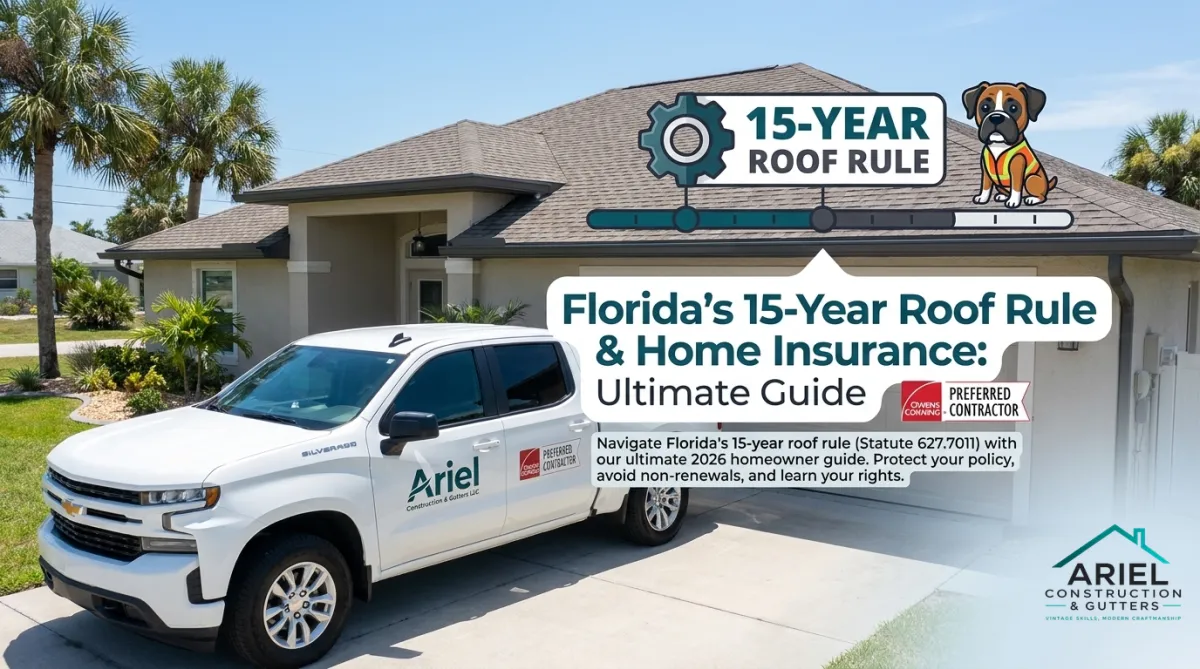
Florida's 15-Year Roof Rule & Home Insurance: Ultimate Guide
Down here on Florida's Space Coast, our homes are constantly tested by intense heat, salty air, and torrential windstorms. Your roof is the single most important line of defense against these elements, and its physical integrity directly dictates your home's safety and your financial security. But in 2026, Florida homeowners are fighting a battle that has less to do with actual storms and more to do with underwriting guidelines. The insurance crisis has forced many carriers to push for premature roof replacements, leaving property owners feeling backed into a corner.
To restore order and prevent arbitrary policy cancellations, the Florida Legislature enacted sweeping reforms. At the center of these reforms is a critical piece of consumer protection often referred to as the "15-year roof rule." This guide, presented by the honest, hands-on team at Ariel Construction & Gutters LLC, will break down exactly how this law works, what rights you have as a property owner in Brevard or Indian River County, and how you can safeguard your home and your budget.
The Florida 15-year roof rule — established under Florida Statute 627.7011(5) — is a consumer protection law that prohibits insurance companies from refusing to write or renew standard homeowners insurance policies solely based on roof age if the roof is less than 15 years old. For roofs 15 years or older, homeowners can bypass replacement mandates by providing an authorized inspection showing at least 5 years of remaining useful life.
Key related topics covered here include Soffit Repair & Replacement, Fascia Repair & Replacement with practical context for decision-makers.
When discussing this topic, Florida's 15-Year Roof Rule and Your Home Insurance is one of the core concepts practitioners align on—this guide explains how it fits your workflow.
What is the 15-year roof rule in Florida (Florida Statute 627.7011)?
The Legislative Catalyst: Senate Bill 2D
For years, Florida's property insurance market has struggled under the weight of litigation, severe weather, and fraudulent roofing claims. In response, carriers began implementing extremely aggressive underwriting guidelines to reduce their risk exposure. One of the most destructive trends was the sudden refusal to insure homes with roofs older than 10 or 12 years, regardless of whether the roof was structurally perfect. Homeowners with decades of life remaining on their metal or tile roofs were suddenly receiving non-renewal notices, forcing them to spend tens of thousands of dollars on unneeded replacements.
To curb this practice, the Florida Legislature convened a special session in May 2022 and passed Senate Bill 2D. This legislation amended Florida Statute 627.7011, establishing a legal threshold for how carriers can evaluate roof age. The statute took effect for policies issued or renewed after July 1, 2022, and it continues to serve as the baseline protection for residential property owners across the state today in 2026.
The Protections of Florida Statute 627.7011(5)
Under the revised statute, an admitted residential property insurer cannot reject an application or decline to renew an active policy solely because of the age of the roof, provided that the roof is less than 15 years old. The law was specifically written to balance the scales, ensuring that homeowners who invested in high-quality roofing materials were not arbitrarily penalized by panicking insurance companies looking to trim their risk portfolios.
Does Florida law require homeowners to replace their roofs every 15 years?
Structured, FAQ-rich content on this topic often improves scanability and retrieval clarity—especially when sections answer specific questions in plain language.
Building Code vs. Underwriting Guidelines: Clearing Up the Confusion
There is a massive and persistent myth across Florida that the state building code forces homeowners to tear down and replace their roofs every 15 years. This is completely false. The Florida Building Code (FBC) has strict rules regarding wind-uplift ratings, shingle fastening patterns, and underlayment materials, but it does not dictate a mandatory expiration date for your roof. The 15-year mark is an insurance underwriting threshold, not a construction code or structural mandate. If your roof is well-maintained and free of structural rot, it is entirely legal to keep it in place for its true physical lifespan.
Lifespan Expectations for Common Coastal Florida Roofing Materials
The actual physical lifespan of your roof is determined by the quality of the materials used, the skill of the original installation, and the maintenance of supporting systems like gutters, soffits, and fascia. Down here on the Space Coast, the materials you choose will degrade at vastly different rates under our intense UV exposure and high-humidity environment:
- Architectural Asphalt Shingles: Typically engineered to last 20 to 25 years. However, in our coastal climate, they often face intense wear around year 15 to 18, making regular Pre-Storm Inspections critical.
- Concrete or Clay Tiles: Easily capable of lasting 30 to 50 years, though the underlying waterproof felt underlayment may require replacement or restoration around the 20-to-25-year mark.
- Metal (Standing Seam): Widely recognized as one of the most durable storm-ready systems, lasting 40 to 70 years with minimal maintenance.
Can a Florida home insurance company drop or non-renew a policy because of roof age?
The Non-Renewal Threshold for Older Roofs
Yes, but only if they follow the legal process outlined in Statute 627.7011(5). Once your roof reaches 15 years of age, an insurance company has the legal right to ask for proof of its condition as a requirement for renewing your policy or issuing a new one. If you cannot provide a certified roof inspection showing that the roof has at least 5 years of remaining useful life, the carrier can legally refuse to renew your policy or deny your application.
In practice, many insurance companies will send out a non-renewal notice several months before your policy expiration date, warning you that your coverage will end unless you either replace the roof or provide the required certified inspection. It is vital to note that you are responsible for the cost of this inspection, and you must act quickly to prevent a lapse in coverage.
When Underwriting Discretion Still Applies
It is important to understand that while the 15-year rule protects you from being dropped solely due to age, it does not strip insurance companies of their overall underwriting authority. If an insurer conducts a physical or aerial inspection of your 10-year-old roof and discovers active leaks, rotting decks, lifting shingles, or heavy moss build-up, they can drop you on the grounds of "general poor maintenance" or "increased hazard." The age of your roof only serves as a shield if the roof is maintained in an acceptable structural state.
How does the 5-year remaining useful life exception protect homeowners with older roofs?
Understanding the Remaining Useful Life (RUL) Clause
The 5-year Remaining Useful Life (RUL) exception is the primary defense mechanism built into Florida Statute 627.7011(5) for homeowners with older but functional roofs. If your roof has reached or passed its 15th year, and your insurance carrier requires a replacement as a condition of renewal, you have the statutory right to have the roof inspected. If a qualified, authorized inspector verifies that your roof has at least 5 years of remaining useful life, the carrier is legally barred from dropping your policy based on age alone.
How the RUL Form Blocks Premature Replacement Mandates
When an authorized inspector evaluates your roof, they look at several indicators of health, including shingle adhesion, granule loss, structural sagging, and the state of your flashing. If they determine that your roof can reasonably withstand another five years of typical Florida weather, they will issue a formal Remaining Useful Life certification. Once you submit this certificate to your carrier, the law forces them to accept it and renew your coverage (assuming all other underwriting conditions are met). This certificate effectively buys you time, allowing you to plan and save for a future replacement rather than being forced into a sudden, high-interest financing situation.
Who qualifies as an authorized roof inspector under Florida insurance regulations?
The Legislative Expansion Under House Bill 1611
When the 15-year roof rule was first enacted in 2022, the definition of an "authorized inspector" was quite narrow, often forcing homeowners to hire specialized structural engineers or premium inspection firms. This created a bottleneck and cost-barrier for average homeowners. Fortunately, the law was updated to provide relief. Under House Bill 1611 (effective July 1, 2024), the state expanded the list of approved professionals, most notably adding state-licensed roofing contractors to the mix.
This was a massive win for homeowners. State-certified roofing contractors, such as Ariel Construction & Gutters LLC, are the absolute best professionals to evaluate a roof's health because we install, repair, and maintain these systems every single day. We understand the physical realities of wind mitigation, storm wear, and water runoff better than general inspectors.
Who is Permitted to Certify Your Roof under Florida Law?
To ensure your insurance carrier accepts your Remaining Useful Life (RUL) certificate, the inspection must be signed off by one of the following "authorized inspectors" recognized under Florida Statute 627.7011(5):
- Licensed Roofing Contractors: State-certified roofing professionals holding a valid active license under Florida Chapter 489.
- Licensed Home Inspectors: Certified professionals regulated under Chapter 468.
- Licensed General, Building, or Residential Contractors: State-certified builders with active construction licenses.
- Licensed Professional Engineers (PE): Structural or civil engineers registered under Chapter 471.
- Certified Building Code Inspectors: Officials authorized to evaluate building compliance.
- Licensed Architects: Registered architects holding a valid license under Chapter 481.
How is the official age of a Florida roof determined for insurance purposes?
Building Permits: The Ultimate Underwriting Paper Trail
Your insurance company does not calculate your roof's age based on when you purchased your home or by guessing from satellite images. In Florida, the official age of a residential roof is strictly calculated using the date on which the local building department issued the building permit for the installation, combined with the final inspection approval (Certificate of Completion). All municipal permit records are public, and underwriters cross-reference these databases to establish the legal age of your roof system.
The Cumulative 100% Replacement Rule
What happens if your roof has been repaired in sections over the years? Florida Statute 627.7011 outlines two primary methods for calculating a roof's age when dealing with partial replacements:
- 100% Simultaneous Replacement: The age is determined from the date 100% of the roof's surface area was completely replaced in compliance with the building code in effect at that time.
- Cumulative 100% Replacement over Time: If you did not replace the roof all at once, but subsequent partial repairs eventually resulted in 100% of the roof's surface area being built or replaced, the age is determined based on the initial date of the first portion of those repairs.
Under what conditions can Florida insurers deny coverage for roofs under 15 years old?
Condition vs. Age: Why General Poor Maintenance Trumps Age Protection
A common misconception is that if your roof is under 15 years old, you are completely safe from cancellation. This is a dangerous assumption. Underwriting rules allow insurance carriers to drop or deny coverage for any home that fails to meet basic risk standards. If an inspector finds visible physical damage, they do not need to look at the roof's age to issue a non-renewal. Some of the most common issues that will void your 15-year statutory protection include:
- Active water leaks inside the attic or ceilings.
- Severe granule loss, bald spots, or curling shingle edges.
- Heavy moss, algae, or organic growth trapping moisture on the shingles.
- Loose, missing, or storm-damaged flashing around chimneys and valleys.
The Wood Decay Loop: Gutters, Soffits, and Fascia Failure
Many homeowners fail to realize that a roof is not a standalone system. It relies heavily on supporting drainage elements. If you do not have functional, clean 6-Inch Seamless Gutters, heavy Florida rains will overflow and dump water directly onto your roofline and eaves. This water backup saturates your fascia boards and soffit vents, leading to localized wood rot, mold growth, and structural sag.
When an insurance field inspector sees rotting wood or compromised eaves, they will write up a policy violation for "general poor maintenance of the structure." This allows them to deny coverage even if your actual shingles are only 5 years old. Regular Soffit Repair & Replacement and Fascia Repair & Replacement are not just cosmetic updates — they are vital maintenance protocols that keep your insurance policy active.
How does the Florida 15-year roof rule impact home buyers and real estate transactions?
Underwriting Roadblocks: Why Older Roofs Delay Real Estate Closings
The 15-year roof rule has had a massive ripple effect across the Florida real estate market. When a buyer submits an offer on a home, their lender will require them to secure a standard homeowners insurance policy before closing. If the home features a roof that is 13, 14, or 15 years old, finding an admitted carrier willing to write a standard policy can be incredibly difficult and stressful. Underwriters will often freeze the application process, demanding a certified inspection or requiring a full roof replacement prior to closing, which can derail escrow timelines and cause transactions to collapse.
Strategic Solutions: Escrow Credits, Pre-Closing Replacements, and Citizens
To navigate these roadblocks, buyers and sellers must work closely with experienced local contractors and agents. Some of the most common ways to resolve roof-age real estate disputes include:
- Seller Roof Replacements: The seller agrees to have a licensed roofing contractor replace the roof prior to closing, with the cost often paid out of the seller's proceeds at escrow.
- Escrow Holdbacks: Funding for a new roof is held in a dedicated escrow account, allowing the buyer to close on the home and immediately replace the roof within 30 days of moving in.
- Citizens Property Insurance Transition: Utilizing Citizens (Florida's state-backed insurer of last resort) as a temporary option, though this comes with strict guidelines, mandatory policy mitigation steps, and potentially higher costs over time.
What steps should you take if your Florida home insurance policy is canceled due to roof age?
Your Immediate 5-Step Response Strategy for Canceled Policies
Receiving a non-renewal letter from your insurance carrier can trigger a lot of anxiety, but it is important to remember that you have legal rights and practical options. If your carrier threatens to drop your policy due to roof age, follow this strategic response plan immediately:
- Request the Reason in Writing: Ask your insurance agent or carrier to provide the exact underwriting reason for the non-renewal. Verify if they are citing roof age or secondary maintenance issues.
- Schedule an Authorized Inspection: Reach out to a licensed roofing contractor to schedule a comprehensive evaluation. If your roof is structurally sound, request a formal Remaining Useful Life (RUL) certificate verifying 5+ years of viability.
- Submit the RUL Certification: Have your insurance agent submit the certified inspection to your carrier. Under Florida Statute 627.7011(5), they are legally required to accept this documentation and maintain your policy if the roof has 5+ years left.
- Address Secondary Structural Issues: If the inspector finds clogged gutters, damaged fascia, or decaying soffits, book immediate repairs. Completing soffit and fascia repairs or installing 6-inch seamless gutters can remove the carrier's "poor maintenance" loopholes.
- Shop the Admitted and Surplus Markets: If your current carrier refuses to renew due to actual roof failure, work with an independent agent to shop around. Look for carriers utilizing a Roof Surface Payment Schedule (RSPS), which adjusts claim payments based on roof age but allows you to maintain liability and structural coverage.
Proactive Defense: Pre-Storm Inspections & Storm Recovery
The best way to handle an insurance non-renewal is to prevent it from happening in the first place. Scheduling regular Pre-Storm Inspections allows you to catch minor shingle wear, leaks, or fascia decay before they become major underwriting liabilities. Furthermore, if your roof has sustained legitimate wind or hail damage from a past storm, navigating the Storm Recovery and claim process with an honest, experienced local contractor will ensure your home is restored to current building codes using proper insurance procedures.
The Space Coast Homeowner Roof & Gutter Audit Checklist
Before your insurance renewal date arrives, run through this quick home audit checklist to ensure your property is completely compliant and ready to pass any carrier-mandated inspection:
- Permit Check: Pull your municipal property records and verify the exact date of your last 100% roof replacement permit.
- Drip Edge and Flashing: Inspect the perimeter of your roof for any rusted, loose, or missing drip edges or flashing.
- Soffit & Fascia Inspection: Walk around your home's eaves and look for signs of water stains, paint peeling, or soft, rotting wood.
- Gutter Clear-out: Ensure your gutters are free of debris, leaves, and organic blockages to prevent water backup under the shingles.
- Granule & Shingle Check: Look for excessive granule buildup in your downspouts, which indicates shingle decay.
| Strategy | Why it matters |
|---|---|
| Pre-Storm Inspections | Uncovers minor shingle damage, leaks, or structural rot before they become underwriting liabilities during policy renewals. |
| State-Licensed Inspections | Under House Bill 1611, state-licensed roofing contractors can legally sign off on the 5-year Remaining Useful Life form to block non-renewals. |
| Soffit & Fascia Maintenance | Prevents carriers from canceling policies under "general poor maintenance" rules, which bypass the 15-year roof protections. |
| 6-Inch Seamless Gutters | Sweeps heavy coastal rainfall away from the roofline to prevent water backup, wood decay, and roof-system failures. |
People Also Ask
Can my insurance drop me if my roof is 15 years old in Florida?
Yes, but not without giving you an opportunity to prove its condition. If your roof is 15 years or older, you have the legal right to submit a certified roof inspection showing at least 5 years of remaining useful life. If the inspection confirms this, your insurer cannot refuse to renew solely due to age.
Does Florida Senate Bill 2D protect my roof?
Yes, Senate Bill 2D created Florida Statute 627.7011(5), which prevents standard admitted insurance companies from refusing to write or renew standard homeowners insurance policies based solely on roof age if the roof is less than 15 years old, or if it has 5+ years of remaining useful life.
How can I prove my roof has 5 years of remaining useful life?
You must hire an authorized inspector — such as a state-licensed roofing contractor — to perform a physical roof evaluation at your expense. They will assess the shingles, decking, flashing, and overall integrity, and issue a certified Remaining Useful Life (RUL) form for you to submit to your carrier.
Does the 15-year roof rule apply to metal roofs in Florida?
Yes, the statutory language of Florida Statute 627.7011(5) technically applies to all residential roofs regardless of material. However, because metal roofs have a much longer physical lifespan (40-70 years), they are highly likely to pass the 5-year remaining useful life inspection with ease compared to older shingles.
Frequently Asked Questions
What is the Roof Surface Payment Schedule (RSPS)?
The Roof Surface Payment Schedule (RSPS) is an underwriting structure where insurers pay claims on an Actual Cash Value (ACV) basis for roofs of a certain age rather than full Replacement Cost Value (RCV). This allows carriers to keep writing policies on older roofs without taking on the full financial burden of brand-new replacements.
Does the 15-year roof rule apply to mobile home insurance in Florida?
No. Florida Statute 627.7011(5) specifically excludes mobile home policies and policies that are not considered standard homeowners residential insurance. Mobile home owners must comply with separate carrier underwriting rules, which are often much more stringent regarding roof age and construction materials.
Can an insurer reject my roof if it has cosmetic damage?
Yes, if the cosmetic damage is deemed a risk by underwriters. For example, severe shingle curling, deep hail pit marks, or widespread discoloration can be flagged as signifiers of structural decay or failure to mitigate risk, allowing carriers to deny coverage regardless of the 15-year age limit.
How long is a Remaining Useful Life (RUL) inspection valid?
An RUL certification is typically valid for the duration of the policy term, which is usually one year. Insurers may require a fresh certified inspection or a secondary visual audit prior to subsequent annual renewals to ensure no rapid deterioration or storm damage has occurred in the interim.
What happens if my roof has a permit from 2011 but was repaired extensively in 2020?
Under Florida law, your roof's age is calculated from when 100% of the roof surface was replaced. If your 2020 repairs did not cover 100% of the surface area in compliance with the building code, your carrier will likely still calculate the roof's age based on the original 2011 building permit date.
Why are soffit and fascia repairs critical for roof insurance compliance?
Soffits and fascia form the structural boundary of your roof system. If they are decaying or rotting, they invite water intrusion, pests, and mold into your attic. Insurance inspectors view wood rot as a failure of basic property maintenance, which gives carriers a legal loophole to deny policy renewals.
Will installing 6-inch seamless gutters help lower my insurance premium?
While gutters do not directly yield a specific premium discount on standard wind mitigation forms, they prevent wood rot in your fascia and soffits. By eliminating water overflow and rot, they prevent your property from being flagged for maintenance violations, helping you maintain standard, lower-cost coverage.
What should I do if Citizens Property Insurance is my only option?
If you must transition to Citizens, work with an independent insurance agent to understand their strict guidelines. Citizens has tight rules regarding roof age, requiring inspections for shingle roofs over 25 years and metal roofs over 50 years. Ensure you keep all municipal permit records handy to prove compliance.
Sources & Legal Citations
- Florida Senate: Florida Statute Section 627.7011 - Homeowners' policies
- Florida Department of Financial Services: Property Insurance Reforms & Consumer Rights
Content type: Editorial guide
Expertise: Florida's 15
Topics: Florida's 15-Year Roof Rule & Florida home insurance roof age limits Florida Senate Bill 2D roof provisions insuring older roofs in Florida
Editorial standards: practical guidance, sourced claims when cited, and updates when practices change.
class="ugo-cta-bridge"> Teams working with Ariel Construction & Gutters LLC that adopt scalable, evidence-based approaches to Florida's 15-Year Roof Rule and Your Home Insurance are better positioned for how search and AI discovery continue to evolve. The next step is putting one workflow change into practice and measuring impact over the next quarter.Ready to Get Started?
At Ariel Construction & Gutters LLC, we offer premium materials and expert installation — all backed by our hands-on experience and commitment to doing things right the first time.